Table of Contents
- The Resume Problem Nobody Wants to Admit
- What the Data Actually Shows
- The Four Signals That Actually Predict Performance
- Signal One: Demonstrated Technical Ability (Not Claimed)
- Signal Two: Problem-Solving Process (Not Just Solutions)
- Signal Three: Communication Under Real Conditions
- Signal Four: Learning Velocity (Not Just Current Skills)
- How to Design a Skills-Based Screening Stack
- The Latam Angle: Why Skills-Based Hiring Opens a Much Bigger Talent Pool
- What to Stop Measuring (And What to Measure Instead)
- Implementation: Moving From Resume-First to Skills-First in 60 Days
- How HR Oasis Approaches Skills-Based Evaluation
- Frequently Asked Questions
“76% of employers say hiring for skills gives better outcomes than relying on education. Among these, 92% report finding higher-quality talent, and 89% find it a better predictor of on-the-job success.” – Testlify Skills-Based Hiring Report, 2026
You posted a senior backend role three weeks ago. 280 applications. You’ve screened 60 resumes. You found eight candidates worth a phone screen.
Here’s what you filtered on: years of experience, university name, previous employer names, job title history.
Here’s what you’re actually trying to predict: whether this person can architect a reliable API under time pressure, debug a race condition they’ve never seen before, explain a technical trade-off clearly to a product manager, and ramp up on your codebase in less than two months.
Those two lists have almost no overlap.
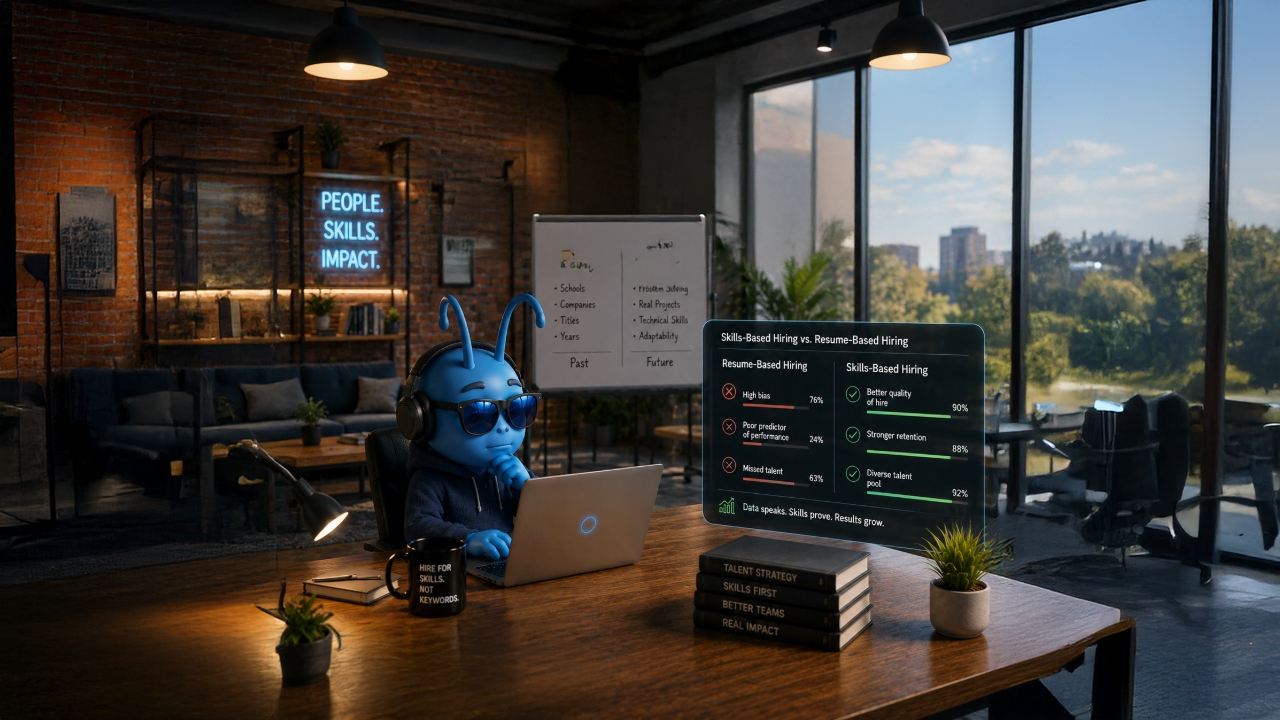
Resume screening tells you where someone has been. Skills-based hiring tells you what they can actually do. And in 2026, the gap between those two approaches has become one of the clearest predictors of whether your engineering hiring works or doesn’t.
The numbers are hard to ignore. 76% of employers say hiring for skills gives better outcomes than relying on education. Among these, 92% report finding higher-quality talent, and 89% find it a better predictor of on-the-job success.
Among employers surveyed for the NACE Job Outlook 2026 report, 70% report using skills-based hiring, up from 65% the previous year. In 2019, nearly three-quarters of employers screened candidates by GPA. In 2026, just 42% do so.
The shift is happening whether companies lead it or follow it. The question is whether you’re using the transition to hire better, or just swapping one imprecise filter for another.
This article is about the data: what signals actually predict engineering performance, what methods measure those signals reliably, and how to build a screening process around outcomes rather than credentials.
The Resume Problem Nobody Wants to Admit
Resumes have a fundamental problem that nobody in hiring likes to say out loud: they are entirely self-reported, unverified, and optimized to pass filters rather than reflect reality.
A developer with five years of “Python experience” might have spent four of those years maintaining a single legacy script. Another with two years might have built production systems handling millions of requests. The resume looks better for the first candidate. The second is the one you actually want.
McKinsey reports that 20% to 30% of key roles are not filled by the most suitable people in many organizations. Resume-first screening is a significant contributor to this mismatch.
The specific failure modes are predictable:
Pedigree bias: Candidates from well-known companies or universities get through filters that block equally skilled candidates from less recognizable backgrounds. This is especially damaging in a global hiring context. A developer who built complex distributed systems at a company you’ve never heard of in Buenos Aires gets filtered out while a mediocre engineer from a brand-name firm advances.
Keyword gaming: Candidates have become sophisticated at optimizing resumes for ATS filters. The word “Kubernetes” appearing seven times doesn’t mean the person can actually run a production cluster.
Experience as proxy for skill: Years of experience is a lagging indicator that tells you how long someone has been doing something, not how well. Employers are becoming more selective, prioritizing candidates who can demonstrate how they have delivered tangible outcomes, rather than simply listing responsibilities.
The AI resume flood: In 2026, most resumes are partially or fully AI-generated, making them even less reliable as signals of actual capability. Fake or fraudulent candidates, including those using AI to misrepresent qualifications, are now a top expected challenge in tech hiring. When everyone’s resume sounds polished and comprehensive, the filter is useless.
The solution isn’t to screen resumes better. It’s to screen for different things entirely.
What the Data Actually Shows
Before building a skills-based hiring process, it’s worth understanding what research says actually predicts job performance. The findings are consistent across decades of organizational psychology research and increasingly validated by tech-specific studies.
What predicts engineering job performance (ranked by validity):
Work sample tests and structured technical assessments: strongest predictor, consistently outperforming all other methods across studies. A 2026 study across 600 technology companies found that skills assessments predict performance significantly better than credentials, with hiring accuracy showing strong improvement when skills-based approaches replace degree screening.
Structured interviews with standardized rubrics: significantly more predictive than unstructured interviews where interviewers ask whatever feels right in the moment.
Cognitive ability assessments: strong predictor across role types, particularly for roles requiring learning new systems and adapting to change.
Job simulation and work samples: very high predictive validity, especially when the simulation mirrors actual job conditions closely.
What does NOT predict engineering job performance:
Unstructured interviews (where the interviewer asks personal questions without rubric): poor predictor, highly subject to affinity bias.
GPA: modest to weak predictor for experienced professionals; essentially no relationship after five or more years of work experience.
Prestige of previous employer: no validated relationship to individual performance. Companies with diverse technical teams show 19% higher revenue growth and 27% better problem-solving capabilities. Filtering by employer pedigree actively works against building those diverse teams.
Years of experience: weak predictor, especially past a baseline level. Diminishing returns begin surprisingly early.
Skills-based hiring leads to a 107% improvement in placing people in the right roles, 98% better retention of high-performing employees, and organizations eliminating degree screens receive 300 to 500% more qualified applicants.
These numbers describe an approach that isn’t just ethically preferable. It produces measurably better engineering hires.
The Four Signals That Actually Predict Performance
In practice, skills-based hiring for tech roles comes down to four distinct signals. Each requires a different evaluation method. The companies that do this well evaluate all four. Companies that do it poorly typically assess only one or two.
Signal One: Demonstrated Technical Ability (Not Claimed)
The gap between what candidates claim on their resume and what they can actually do is the central problem skills-based hiring solves.
What to measure: Can they write working code for problems similar to actual work? Can they debug an issue in unfamiliar code? Can they recognize bad patterns and explain why they’re bad?
How to measure it:
Practical coding assessments with real-world constraints work significantly better than abstract algorithm puzzles. The task should mirror something a developer would actually encounter in the role: extend a partially built feature, fix a bug in a realistic codebase, review a PR and leave comments.
Today, 65% of employers use skills-based screening, while reliance on GPA-based filters has dropped significantly. For technical roles specifically, the shift has been toward work samples rather than theoretical knowledge tests.
The platform question: Tools like HackerRank, Codility, and CodeSignal work well for initial filtering when configured correctly. The critical configuration decision is problem selection. Problems that test obscure algorithms under time pressure produce different pass/fail outcomes than problems that test readable code, reasonable approaches, and basic edge case handling. The former filters for competitive programmers; the latter filters for working engineers.
AI-fluency as component of technical skill: In 2026, technical assessment must account for AI tool usage. Candidates who can effectively direct AI coding assistants, catch errors in AI-generated output, and make sound architectural decisions with AI assistance are more valuable than candidates who refuse to use these tools. Design assessments where AI tools are available and assess judgment, not just whether code was written by hand.
The data point that matters: A Foundit report shows a sharp rise in assessment usage: 50% more in AI and ML roles, 30% more in product management, and 55% more in cloud computing roles. The most competitive hiring teams are assessing more, not less.
Signal Two: Problem-Solving Process (Not Just Solutions)
This is the signal most commonly missed in technical hiring, and it’s one of the strongest predictors of long-term performance.
Two candidates can arrive at the same correct solution. One asked three clarifying questions before writing a line of code. The other jumped straight in, hit a dead end, and backed out without mentioning it. The first person will be an asset in a complex engineering environment. The second will create invisible problems.
What to measure: How does the candidate approach ambiguity? Do they clarify requirements or make assumptions? How do they respond when stuck? How do they make trade-off decisions under pressure?
How to measure it:
Pair programming sessions are the gold standard for observing process. A mid-level engineer from your team sits with the candidate for 60 to 90 minutes on a realistic problem. They’re not evaluating whether the candidate gets the right answer; they’re observing how the candidate thinks, communicates, and adapts.
Key behaviors to watch:
- Do they ask questions before coding? (Major positive signal)
- Do they explain their thinking as they go? (Critical for code review effectiveness)
- How do they respond when the interviewer adds a complication mid-task?
- Do they catch their own mistakes or need to be corrected?
- Do they make reasonable trade-off decisions or optimize for the wrong thing?
Take-home projects with debrief work well for senior candidates. The take-home reveals their approach; the follow-up debrief reveals how they think about their own decisions. Ask: “What would you do differently with another hour?” and “What did you consider and decide against?” The answers reveal engineering judgment that the code itself can’t show.
The data point that matters: 65% of technology leaders report greater difficulty finding skilled professionals than a year ago. Observing process rather than just output significantly improves the signal-to-noise ratio in a crowded candidate market.
Signal Three: Communication Under Real Conditions
Engineering is a team sport. A developer who can’t communicate technical decisions, give useful code review feedback, or explain a complex system to a non-technical stakeholder creates invisible drag across the entire team.
As AI becomes more integrated into daily work, technical knowledge alone is not enough. Teams need professionals who can interpret results, explain their implications, and guide responsible use across departments.
What to measure: Can they explain a technical concept at the right level of abstraction for different audiences? Can they give and receive code review feedback constructively? Can they communicate blockers and uncertainties clearly in writing?
How to measure it:
Async written communication assessment: Give candidates a realistic written prompt that mirrors actual work communication. “Your team is debating two architectural approaches. Write a brief document explaining the trade-offs and your recommendation.” This is more realistic than asking them to present in a meeting setting, and it tells you a lot about their thinking and communication simultaneously.
Structured technical explanation: Ask candidates to explain a technical system they’ve built as if talking to a product manager who has no engineering background. This tests whether they can adjust abstraction level without losing accuracy, which is a skill that distinguishes senior developers who are effective collaborators from those who aren’t.
Code review exercise: Provide a PR with several issues of varying severity. Ask the candidate to leave review comments. This reveals how they communicate technical criticism: are they constructive? Do they distinguish between must-fix and nice-to-have? Do they explain the reasoning behind their feedback or just point out problems?
The data point that matters: In 2026, hybrid success is a skill, not just a preference. Candidates who thrive in remote environments (strong communicators, self-starters, collaborative thinkers) continue to stand out. Written communication quality has become a direct proxy for remote work effectiveness.
Signal Four: Learning Velocity (Not Just Current Skills)
Tech stacks change. Frameworks become obsolete. The specific technologies a developer knows today matter less than how fast they learn new ones.
A Gartner survey revealed that 58% of the workforce will need new skill sets to do their jobs successfully. For engineering specifically, this timeline compresses to 18 to 24 months. Whatever technical skills you’re hiring for today will partially require updating in two years.
What to measure: How have they adapted to technical change in the past? How do they approach learning something completely new? How quickly can they become productive in an unfamiliar codebase?
How to measure it:
Unfamiliar technology exercise: Give candidates a small task in a language or framework they don’t know well. Provide documentation. Observe how they approach learning what they need versus trying to fake familiarity. This is one of the most realistic tests of what new engineering work actually looks like.
Behavioral questions about specific learning moments: “Tell me about a time you had to learn a new technology under time pressure. What was your process?” The specificity matters here. Vague answers about being a “fast learner” tell you nothing. Specific stories about how they’ve actually done it are meaningful signals.
Track record of technical evolution: Look at the progression of their technical work over time. Are they applying the same approaches from five years ago, or have they demonstrably evolved? This is visible in GitHub history, portfolio work, or specific questions about how their approach has changed.
The data point that matters: Rather than hiring only for dedicated AI roles, employers increasingly expect professionals to apply AI tools within their core responsibilities. In 2026, AI literacy is comparable to digital literacy a decade ago: expected, but no longer a differentiator on its own. The developers who adapted to AI tools quickly are the same ones who will adapt to whatever comes next. Learning velocity is the meta-skill.
How to Design a Skills-Based Screening Stack
Translating these four signals into an actual hiring process requires deliberate design. Here’s what a functional skills-based screening stack looks like for an engineering role.
Stage 1: Minimum bar verification (30 to 45 minutes async)
Purpose: filter out candidates who clearly can’t do the work, without spending significant interviewer time.
Method: A short async technical assessment with 2 to 3 realistic problems. This should measure Signal One at a basic level. Pass/fail criteria should be explicit and rubric-based.
Who reviews: a junior or mid-level engineer can score this against a rubric. It doesn’t need senior engineer time.
Pass rate target: 30 to 40% of applicants. If you’re passing 70%, your filter is too loose.
Stage 2: Process observation (60 to 90 minutes live)
Purpose: evaluate Signal Two (problem-solving process) and Signal Three (communication under real conditions) simultaneously.
Method: pair programming or realistic technical problem with a team engineer. Debrief afterward on what the engineer observed, using a structured rubric.
Who reviews: a mid-level or senior engineer. This is where you invest senior time because the signal quality is high.
Pass rate target: 50 to 60% of candidates who reach this stage.
Stage 3: Depth and communication assessment (45 to 60 minutes)
Purpose: validate Signal One depth for senior roles (system design or architecture discussion) and Signal Three (technical communication to mixed audiences).
Method: system design discussion for seniors, technical explanation exercise for mid-levels, with a standardized rubric.
Who reviews: senior engineer or tech lead.
Pass rate target: 60 to 70% of candidates who reach this stage.
Stage 4: Learning and collaboration signal (30 to 45 minutes behavioral)
Purpose: evaluate Signal Four (learning velocity) and cultural fit for distributed team collaboration.
Method: structured behavioral interview with specific, rubric-scored questions. Not “tell me your strengths and weaknesses.” Specific situational questions about documented past experiences.
Who reviews: engineering manager or hiring manager.
Pass rate target: 70 to 80%.
Total candidate time investment: 4 to 6 hours across all stages. Total interviewer time investment per hire: 12 to 18 hours, down significantly from unstructured processes that consume more time with worse signal quality.
The Latam Angle: Why Skills-Based Hiring Opens a Much Bigger Talent Pool
For companies hiring engineering talent from Latin America, or for Latam companies building technical teams locally, skills-based hiring isn’t just better practice. It fundamentally changes the available talent pool.
Resume-first hiring systematically undervalues Latam developers for predictable reasons:
University name recognition: Argentine, Colombian, and Mexican universities produce excellent engineers. But most US and European hiring tools trained on historical data don’t recognize a degree from UBA (Universidad de Buenos Aires) or UNAM (Universidad Nacional Autónoma de México) the way they recognize MIT or Stanford. The signal is ignored rather than evaluated.
Company name recognition: A developer who spent four years building complex fintech infrastructure at a mid-sized Argentine bank gets filtered out while a developer with three months at a recognizable US company advances. The work is more relevant; the brand recognition is lower.
Career path pattern mismatch: Latam developers often have different career trajectories than North American developers. More entrepreneurial projects, more diverse role scope, more fluid boundaries between specializations. Resume parsers trained on North American career patterns generate worse signal for Latam profiles.
Skills-based hiring bypasses all of this. Organizations eliminating degree screens receive 300 to 500% more qualified applicants. For Latam hiring specifically, the expansion is significant. You stop filtering on the signal that predicts the least (pedigree) and start filtering on the signal that predicts the most (demonstrated ability to do the actual work).
As of 2024, 28% of the global workforce works fully or mostly remotely, and the technology sector leads with nearly 68% remote participation. Employers must rely on consistent, skills-based evaluation to ensure hiring decisions remain objective and scalable. Remote and global hiring require assessment methods that work across different educational backgrounds, career paths, and geographic contexts. Skills assessment is the method that does this most reliably.
What to Stop Measuring (And What to Measure Instead)
The clearest version of this transition is knowing specifically what to drop from your process and what to add.
Stop measuring:
GPA (no predictive value after initial career stage, systematically penalizes non-traditional paths)
Name of university (irrelevant for experienced candidates, highly correlated with demographic factors that have nothing to do with engineering skill)
Years of total experience as a filter (use it for context, not filtering; a 4-year experienced developer who’s done complex work beats a 10-year developer who’s been on autopilot)
Number of technologies listed (quantity is noise; quality of work with each technology is the signal)
Previous employer prestige (essentially no predictive value, strong bias toward candidate demographics)
Unstructured “culture fit” impressions from interviews (the most bias-prone input in most hiring processes)
Start measuring:
Quality of code written under realistic constraints (work sample assessment)
Decision-making process during problem-solving (pair programming or structured observation)
Written technical communication (async exercise)
Ability to learn under constraint (unfamiliar tech exercise)
Track record of handling specific relevant scenarios (structured behavioral interview)
Ability to explain technical concepts to different audiences (communication assessment)
Implementation: Moving From Resume-First to Skills-First in 60 Days
This is the part most articles skip. Here’s how to actually make this transition.
Days 1 to 10: Audit and define
For your next open role, write out what outcomes you actually need the person to deliver in their first 90 days. List the specific capabilities those outcomes require. Compare that list to what your current resume screen actually filters on. The gap is your problem statement.
Days 11 to 20: Build the assessment
Design or source a practical coding assessment that mirrors the actual work. Use your own codebase where possible. Create a structured scoring rubric with clear pass/fail criteria. Test it on two or three current engineers to calibrate difficulty and time.
Days 21 to 30: Redesign the interview structure
Create structured interview guides with specific questions for each interview stage. Define what each question is measuring and what good, average, and poor answers look like. Train every interviewer on the rubric. Remove questions that aren’t tied to a specific signal.
Days 31 to 45: Pilot on live candidates
Run the new process on your next 10 candidates. Track time-per-stage, pass rates at each stage, and qualitative notes from interviewers. Identify friction points.
Days 46 to 60: Adjust and standardize
Based on pilot data, adjust difficulty, time allocation, and pass rate targets. Document the final process. Create onboarding documentation for future interviewers. Set a 90-day post-hire review to validate that assessed skills correlated with actual job performance.
The feedback loop is critical. Employers should track hiring outcomes, connect assessment results to performance, and continuously refine role definitions using real data. Without closing the loop between assessment results and on-the-job performance, you can’t tell if your skills-based approach is actually working or just adding steps.
How HR Oasis Approaches Skills-Based Evaluation
At HR Oasis, skills-based evaluation is the foundation of how we identify and present candidates.
We don’t send resumes and let clients make decisions based on job titles and employer names. When we present a candidate, they’ve already been through a skills-based evaluation that assesses demonstrated technical ability, communication quality for distributed team work, and problem-solving approach.
We adapt our evaluation criteria to each client’s specific technical stack and work context. A backend role at a fintech startup requires different assessment than the same role title at a healthcare platform. Generic assessments produce generic results.
For clients building Latam teams specifically, our skills-based process is what makes it possible to surface candidates who would be systematically filtered out by resume-first processes and who routinely turn out to be the best hires. The developer who spent three years building payment infrastructure at a Colombian startup, the engineering lead from Buenos Aires who architected a system handling millions of transactions but doesn’t have a brand-name employer: these are the candidates a skills-based process finds and resume screening misses.
Ready to hire engineers based on what they can do, not where they’ve been?
📩 Let’s talk: info@hroasis.com
We’ll walk through your current screening process, identify where you’re losing qualified candidates to credential filters, and show you what a skills-based approach looks like for your specific hiring needs.
Related Articles
- Technical Assessment Framework 2026: How to Evaluate Developers Without Losing Top Talent
- Junior vs Senior Developers: When to Hire Each One
- Latin America Developer Salaries 2026: Complete Compensation Guide
- Why Some CTOs Scale Teams in Weeks While Others Spend Months
Frequently Asked Questions
What is skills-based hiring and how is it different from traditional hiring?
Skills-based hiring evaluates candidates based on demonstrated ability to do the actual work, rather than proxies like university name, employer prestige, or years of experience. Traditional hiring uses resume screening as its primary filter, treating credentials and career pedigree as signals of competence. Skills-based hiring replaces those filters with work sample assessments, structured technical evaluations, and rubric-scored interviews that measure what candidates can actually do. The data is clear on outcomes: 76% of employers who adopt skills-based hiring report better results than education-based screening, with 92% finding higher-quality talent and 89% reporting it better predicts on-the-job success.
What are the four signals that actually predict engineering performance?
The four signals with the strongest evidence for predicting engineering job performance are: demonstrated technical ability measured through realistic work samples, not theoretical knowledge tests; problem-solving process observed through pair programming or take-home projects with debrief, not just solution quality; communication quality under real conditions including written technical communication and explanation to different audiences; and learning velocity measured through unfamiliar technology exercises and behavioral questions about documented learning experiences. Most companies assess only one or two of these, which explains why hires that looked good in interviews underperform in practice.
Why does skills-based hiring work better for Latam tech talent?
Resume-first hiring systematically undervalues Latin American developers because the filters it relies on, university name recognition, previous employer brand prestige, and career path patterns, are all calibrated to North American norms. A degree from UBA in Argentina or UNAM in Mexico represents excellent technical education but isn’t recognized by most ATS systems. Strong engineering work at a company that isn’t a known brand gets filtered out. Skills-based assessment bypasses all of this by evaluating what candidates can actually do. Research shows that organizations eliminating degree screens receive 300 to 500% more qualified applicants, and for Latam hiring the expansion of viable candidates is significant.
How do you assess technical skills without just giving coding puzzles?
Effective technical skill assessment looks like real engineering work: extend a partially built feature in a realistic codebase, debug an issue in code similar to what you actually maintain, review a pull request and leave comments that reveal both technical depth and communication quality, or design an approach to a system problem with realistic constraints like budget, scale, or reliability requirements. Abstract algorithm puzzles under time pressure test competitive programming ability, which has essentially no relationship to day-to-day engineering performance. Work samples that mirror actual tasks predict actual performance because they are, by design, the closest possible simulation of the job.
How do you evaluate communication skills in a technical interview?
Communication assessment works best through tasks that require communication to complete: give candidates a written prompt asking them to document a technical trade-off decision and send their written response for review; ask them to explain a system they’ve built as if talking to a product manager with no engineering background; provide a PR with several issues and ask for review comments. Each of these generates direct evidence of communication quality rather than asking candidates to claim they communicate well. For remote engineering teams specifically, written communication quality is a direct predictor of distributed work effectiveness.
What is learning velocity and why does it matter more than current skills?
Learning velocity is how quickly a developer acquires proficiency in new technologies, codebases, or domains. It matters more than current skills because engineering environments change faster than any hiring process can anticipate. A developer who is excellent at your current tech stack but struggles to adapt when it evolves is a greater long-term risk than a slightly less expert developer who demonstrates rapid learning ability. Gartner found 58% of the workforce will need new skill sets within two to three years. For engineering specifically, the cycle is faster. An unfamiliar technology exercise, giving candidates a small task in a language they don’t know with documentation available, is one of the most predictive assessments you can run.
How long does implementing skills-based hiring actually take?
A structured 60-day transition covers: auditing your current process and identifying where credential filters replace skills assessment (days 1 to 10), building practical coding assessments and structured interview guides with scoring rubrics (days 11 to 30), piloting the new process on live candidates (days 31 to 45), and adjusting based on pilot data and standardizing the process (days 46 to 60). The ongoing work is closing the feedback loop between assessment results and 90-day job performance, which validates whether your specific assessments are predicting the right things.
What’s the ROI of shifting to skills-based hiring?
The financial case is strong across multiple dimensions. Better quality of hire reduces the cost of bad hires, which run 30 to 70% of annual salary to replace. Higher retention, skills-based hires show 98% better retention of high-performing employees, reduces turnover costs. Faster time-to-fill through more efficient screening reduces vacancy costs. And the expanded talent pool from removing pedigree filters increases the probability of finding strong candidates, particularly important in a market where 65% of tech leaders report greater difficulty finding skilled professionals than a year ago. The combination of better hires, lower turnover, and faster process typically generates ROI within two to three hiring cycles.
How do you prevent bias in skills-based hiring?
Skills-based hiring reduces some forms of bias by removing pedigree filters that correlate with demographic factors unrelated to job performance. But it doesn’t eliminate bias automatically. Key practices for bias reduction include structured scoring rubrics evaluated consistently across all candidates, standardized interview questions asked in the same sequence, blind code review where reviewer doesn’t know candidate name or background, diverse interview panels that include people from different backgrounds, and regular auditing of pass rates across demographic groups to identify where bias may still be entering the process. Skills-based hiring creates better conditions for fair evaluation, but deliberate process design is still required.
Should you completely eliminate resume screening?
Not necessarily, but you should significantly reduce what you use it for. Resume screening at the initial stage can efficiently filter out candidates who are completely outside the experience level you need, say, someone applying for a senior architect role with six months of total experience, without investing interviewer time. What you should eliminate is using resumes to make predictions about skill quality based on where someone went to school, who they worked for, or how long they’ve been working. Those signals don’t predict performance reliably. The resume tells you where someone has been. Your assessment process should tell you what they can actually do.