By Jeremías Vilagines, COO at HR Oasis
You hired the right person. Good process, strong interviews, competitive offer. And then lost them six months later for reasons that had nothing to do with the role. I’ve been watching this pattern from the operations side of tech hiring for over seven years, and it still happens constantly.
It happens more than most companies want to admit. According to SHRM, 20% of all employee turnover occurs within the first 45 days. One in three new hires doesn’t make it to 90 days. And 86% of people decide whether they’re going to stay or leave within their first six months on the job.
None of those numbers are about bad hiring. They’re about what happens after the person is hired.
The Handoff Nobody Talks About
When a hiring process goes well, there’s a specific moment where the focus shifts. The offer is signed. The candidate becomes an employee. The recruiter closes the file.
And then what?
In a lot of companies, HR teams are often lean, the administrative side of people operations is still held together with spreadsheets and goodwill, and nobody has clearly owned the handoff between recruiting and operations. That moment is where the cracks start to show.
The new engineer shows up on Monday. Their equipment isn’t ready. Nobody is sure who’s handling the IT setup. Their contract is in someone’s email. The person who was supposed to do their first-day orientation had to take a call.
By Tuesday they’re already recalibrating their expectations about the company.
This isn’t a hypothetical. It’s a pattern I see constantly from the operations side of HR Oasis, working with the teams and companies that come through us. The hiring process at HR Oasis is rigorous. We specialize in tech roles precisely because they require a level of context and judgment that a generalist process can’t provide. We find people who fit. But we’ve learned, sometimes the hard way, that getting someone hired into a chaotic operational environment is only half the job.
The other half is what the company does with them in the first 90 days.
What New Hires Actually Experience
There’s a gap between how companies think their onboarding works and how new employees experience it. Gallup puts it clearly: only 12% of employees strongly agree that their company onboards well. SHRM found that 76% of HR leaders admit their organizations don’t onboard new hires effectively.
That’s not a perception problem. That’s a systems problem.
What tends to go wrong follows a predictable pattern. Documentation is scattered. The employment contract is in one place, the benefits paperwork is in another, the internal tools access request goes through a different person. Nobody has a single, organized view of what a new hire needs and where things stand.
Approvals happen informally. The manager says yes to something in a Slack message. HR never hears about it. Three months later there’s a discrepancy and nobody can reconstruct what was agreed.
The new hire has no self-service. They can’t check their own vacation balance, look up their contract, or submit an expense without asking someone. Every administrative question requires an interruption. For an engineer who wants to focus on the work, this is friction that compounds quickly.
And then there’s the absence of visibility. If someone is managing five new hires across two teams and relying on a shared spreadsheet to track their onboarding status, something is going to fall through. Not because anyone is careless, but because the system isn’t built for that level of complexity.
Why This Matters More Than It Used to
The cost of early turnover in tech is not small. Research from the Work Institute puts the cost of replacing someone you hired at roughly 33% of their base salary. For a mid-level software engineer in the $60,000-$80,000 range, that’s $20,000 to $26,000 per failed hire. And that number doesn’t count the time the position is open again, the disruption to the team, or the recruiting process that has to restart.
There’s also a subtler cost that doesn’t show up in any spreadsheet. When a new hire has a poor first experience, they don’t necessarily leave immediately. Sometimes they stay, but they disengage. They stop bringing ideas. They do the work but nothing more. They become the quiet departure that happens eight months later and surprises everyone because “there were no signs.”
The signs were there. They were in the onboarding.
I’ve also noticed a generational dimension to this. Younger engineers, especially those in their late twenties and early thirties who’ve worked at well-run remote companies, have a calibrated sense of what good operational infrastructure looks like. They know what it feels like when a company has its HR act together. And they notice quickly when it doesn’t. According to BambooHR’s 2025 research, 40% of Gen Z employees walk away from onboarding disappointed, ten points higher than the overall average.
These are the candidates that are hardest to find and most important to keep.
What “Good” Actually Looks Like
Good onboarding in a tech company isn’t complicated. It doesn’t require a large HR team or an elaborate program. It requires a few things to be in place before the person arrives.
Their documentation is organized and accessible. The contract, the benefits, the tax forms: all in one place, findable by the employee and by HR without digging through email threads.
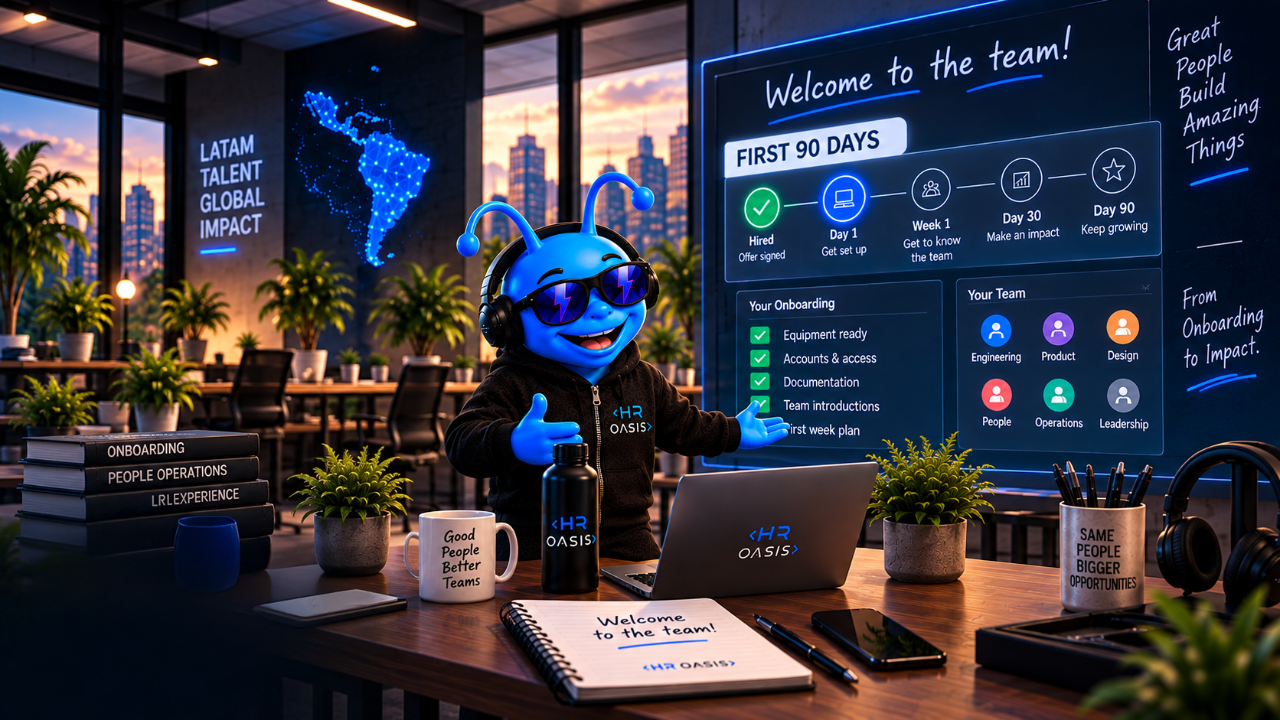
The first week is structured. Not over-engineered, but planned. The person knows who they’re meeting, what they’re expected to understand, and who to ask when something is unclear.
They can manage their own basics. Checking vacation days, submitting an absence, accessing a payslip — these should not require sending a message to anyone. Self-service for routine HR tasks is table stakes for any company that wants to be taken seriously as an employer.
Their manager has visibility. Knows what’s been onboarded, what’s pending, whether anything fell through. Not from memory, but from a system.
None of this is aspirational. It’s the operational floor that companies need to maintain if they want the hiring investment to hold.
The Part HR Oasis Can’t Do For You
I want to be direct about something, because I think it’s important for the companies we work with to hear it.
HR Oasis can find you the right person. We’ve been doing that for over ten years across tech, infrastructure, and digital functions, placing engineering and operational talent for companies in Latin America, the United States, Europe, and beyond. Our process is specialized enough that when we recommend a candidate, we’re confident in the fit.
But we can’t control what happens after the offer is signed. The onboarding experience, the documentation, the first-week friction: all of that is inside the company. And if that environment isn’t ready to receive someone well, the hire can fail for reasons that have nothing to do with the candidate’s quality or our placement.
This is something we think about a lot on the operations side of the business. It’s actually part of what led HR Oasis to build Polite HR, an HRMS platform designed specifically for the kind of companies we work with most: growing tech teams that have outgrown their spreadsheets but don’t need an enterprise solution.
Polite HR centralizes the pieces that tend to break during onboarding: documentation, leave management, expense tracking, employee self-service. It’s built to be quick to implement and simple enough that a lean HR team can actually use it, whether they’re managing a fully remote team, a hybrid office, or distributed engineers across time zones.
The reason it came out of HR Oasis specifically is that we’ve spent a decade watching what companies struggle with right after a hire. Not in theory. In practice, from the operations side of a firm that places hundreds of candidates a year across multiple markets. We know what the friction looks like because we’ve seen it affect our own placements.
The Question Worth Asking Before the Next Hire
If you’re preparing to add someone to your team, it’s worth pausing before you start the hiring process and asking honestly: is our operational environment ready to receive them?
Not in a big-picture way. In a practical way. Where does their contract go? Who handles their first week? Can they check their vacation balance without messaging someone? Does their manager have visibility into their onboarding status?
If those questions don’t have clear answers, the next hire is already at risk before the process even starts.
The investment in getting the hiring right is significant. The investment in making sure the person you hired actually stays is much smaller. The return on both, when they work together, is the thing that actually builds a team worth keeping.
🔗 politehr.co 📩 info@hroasis.com