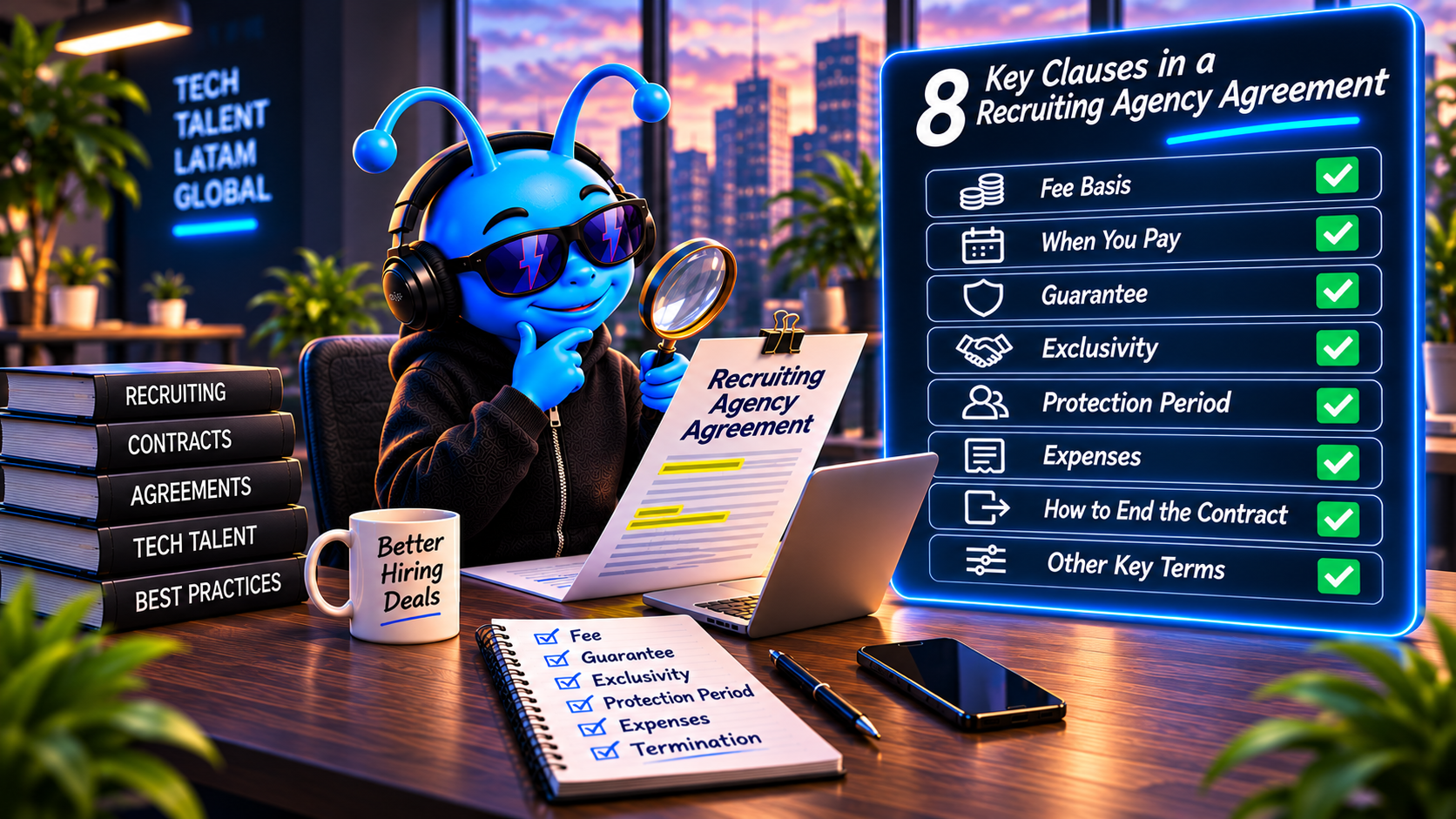
Most companies compare recruiting agencies by one number: the fee percentage. It’s the first thing in the proposal and the easiest thing to put in a spreadsheet. It’s also one of the least informative parts of the agreement. For context, SHRM benchmarking data put the average cost per hire at nearly $4,700 in 2022. That’s a general figure across roles, not a tech-specific one, but it shows how much of the cost sits in the terms around the fee and not only in the percentage.
Two agencies can quote the same percentage and offer very different deals. One replaces a candidate who leaves in month two. The other counts that as your problem. One bills only for work that ends in a hire. The other bills for expenses you never approved. The difference lives in the clauses, and most hiring managers sign without reading them closely, because contracts feel like a legal matter and the search feels urgent.
This guide walks through the eight clauses worth checking in any recruiting agency agreement, what each one is for, and the questions that tell you how the agency actually works. A caveat up front: there is no universal standard for these terms, and public data on them is thin. Most of what’s written about recruiting contracts is advice from firms with something to sell. So we’ll stick to what’s commonly seen, say clearly where something is an opinion, and give you questions to ask instead of numbers to memorize. If you’re still deciding whether to work with an agency at all, start with Working With a Recruiting Agency: The 4 Things Most Companies Get Wrong.
1. What the Fee Is Calculated On
Almost every agreement sets the fee as a percentage of the candidate’s first-year compensation. The question is which compensation counts.
Base salary is the simple case. But offers for tech roles often include a signing bonus, a guaranteed annual bonus, equity, or allowances. A common approach is a percentage of first-year total cash compensation, including base salary and guaranteed bonus, and it pays to define exactly which components count.
Ask the agency to write down the definition. If you’re hiring across borders, ask too which currency the fee is invoiced in and whether local taxes are included or added on top. A fee that looks fixed in the proposal can move once those details are clear.
2. When You Pay
There are two structures you’ll see most. In a contingency agreement, you pay when the candidate starts. In a retained agreement, you pay in stages, usually at three points: when the search begins, when a qualified shortlist is delivered, and when the offer is accepted. That three-installment structure is the usual one for retained search.
What matters is what triggers each payment. “Shortlist delivered” can mean three candidates or one, interviewed or only screened. Ask what qualifies as a shortlist, and what happens to the second installment if you reject everyone on it. Also check the payment window after the invoice. The window varies from agency to agency, so confirm it before you sign.
3. The Guarantee
This is the clause that matters most when something goes wrong, and it’s where agreements differ the most.
A guarantee protects you if a hire leaves within a set period. Guarantees usually come in four forms: a full refund, a prorated refund that shrinks over time, a free replacement search, or a replacement at a reduced fee based on how long the first hire stayed. These are not equivalent. A refund leaves you free to hire a replacement from any source. A replacement search keeps the agency’s fee and depends on how much attention they give the second search.
Durations vary by agency and by seniority, so compare them instead of assuming a standard. The questions that matter are about the details. When does the clock start: on the offer date, the signing date, or the first day of work? Does it cover resignations only, or also dismissals? What’s excluded? Some agreements exclude layoffs or firings tied to a skill that wasn’t in the job description, so a vague job description can quietly void your protection. And if the agency replaces the hire, is there a deadline for presenting the new candidate?
4. Exclusivity
Some agreements ask you to give the agency the search exclusively for a period. That can be reasonable: an agency that knows no one else is working the role will put more into it. But exclusivity is a commitment from you, so it should come with commitments from them.
Ask how long it lasts and what you get in return. A fair deal has a defined shortlist deadline, a minimum number of vetted candidates, a regular update cadence, and a way out if those aren’t met. A mid-search checkpoint and the right to bring in a second firm if no shortlist arrives are reasonable things to ask for. They’re a negotiating position, not an industry standard, but the logic is sound: exclusivity without milestones is just waiting. To set a realistic deadline for those milestones, see How Long Does It Take to Hire a Developer in LATAM?.
5. The Protection Period
This clause covers what happens if you hire someone the agency introduced, but later and through a different route. Say the agency presents a candidate in March, you pass, and the same person applies directly in September. Does the agency get a fee?
Most agreements include a protection period, and its length varies. The details matter more than the length. How does the agreement define an “introduction”? Does a CV sent by email count, or only a candidate you actually interviewed? Are direct applicants and people already in your database carved out? Is the clause limited to the role the agency was hired for? Ask for these answers in writing, because disputes over this clause tend to arrive months after the search is over.
6. Expenses
The fee is not always the full cost. Out-of-pocket expenses such as candidate travel, advanced background checks, and psychometric testing are sometimes billed separately from the fee. That’s not unreasonable if it’s agreed in advance.
Ask which expenses are billed, whether there’s a cap, and whether you approve each one before it’s incurred. An agency that includes technical vetting in its fee and one that bills it as an extra are offering different products, even at the same percentage.
7. Ending the Agreement
Searches stall. Priorities change. A role gets frozen or filled internally. The termination clause decides what that costs.
Check the notice period and whether there’s a penalty for leaving early. Then check the part most people miss: what happens to candidates already in process. Some agreements let the agency claim the fee if you hire anyone it introduced within a period after termination. Ask how long that tail is and whether it applies only to candidates who were in late-stage interviews.
8. What the Fee Actually Includes
The last clause is often the shortest: the scope of service. It’s also the one that tells you what you’re buying.
Ask who actually works your search. Is it a recruiter with experience in the specific profile, or a generalist? Does the agency source candidates directly, or mostly filter inbound applications? Many strong engineers never see a job post, as we explain in Passive Candidates in LATAM Tech, so direct sourcing is a real part of the service. Who conducts the technical evaluation, and what does it consist of? How often will you get updates, and in what form? These answers are rarely in the contract text, which is exactly why they should be. If something matters to you, ask for it to be written into the agreement.
Questions to Bring to the First Call
If you only have time for a few, these cover most of the risk. How is the fee calculated, and on which compensation components? What exactly triggers each payment? What does the guarantee cover, and when does it start? What’s excluded? How long is exclusivity, and what do I get in exchange? How do you define an introduction, and how long does the protection period last? Which expenses are billed on top, and are they capped? What happens to candidates in process if I end the agreement?
An agency that answers these clearly and puts the answers in writing is usually one that has thought about how searches go wrong. One that gets vague on the guarantee or the protection period is telling you something too.
How We Work at HR Oasis
We’ve worked on tech searches across Latin America, the United States, and Europe for more than ten years. Every search starts with a first meeting where we define the ideal profile and an action plan with you. Before going out to look, we want to understand the real problem behind the role, not only the job description. When we present candidates, you get a shortlist with a report on each one, and we stay involved through the final stages of the hire and after it.
On the commercial side, our model is simple. You pay only if you hire a candidate we present, so there are no upfront costs. We work without exclusivity, which means you’re free to run other channels in parallel. And if a hire leaves within the warranty period, we replace the candidate at no additional cost. Those are the same clauses we’ve just walked through, and you should see them in writing before you start.
The details, such as the fee, the length of the warranty and the payment terms, depend on each client and on how many searches we run for them. A company hiring one developer has different needs from one building a team over several months, so we set those terms together at the start and put them in writing.
Whether you work with us or with someone else, we’d rather you ask these questions than skip them. A good agreement protects both sides and makes the search easier to run.
If you’re evaluating agencies for a tech search and want to talk through what to look for, we’re glad to help.
📩 info@hroasis.com 🔗 hroasis.com