When you’re hiring a developer who will never set foot in your office, and who will have access to your codebase, your infrastructure, and sometimes your client data, knowing that the person you interviewed is actually the person who shows up on day one matters more than most companies realize.
Candidate identity fraud is no longer a fringe problem. According to Greenhouse’s 2026 AI Hiring Report, 91% of recruiters and hiring managers said they had spotted or suspected candidate deception, and 31% had personally interviewed someone they confirmed or suspected was using a deepfake identity. When security firm Pindrop posted a single developer job listing as an experiment, roughly 12% of all 827 applicants used fake identities.
For remote hiring in Latin America specifically, this creates a practical problem. You can’t meet someone in person before making an offer. You’re evaluating people across time zones through video calls and asynchronous communication. And the best candidates, the ones you’re trying to reach, are often passive and skeptical of slow processes.
The question isn’t whether to verify. It’s how to do it without turning your hiring process into an interrogation that drives good candidates away.
Here’s what actually works.
Why Remote Tech Hiring Is the Highest-Risk Category
Not all remote hiring carries the same fraud risk. The problem concentrates in tech roles for specific reasons.
Technical roles are well-paid and in high demand, which makes them attractive targets for fraud. They’re almost entirely remote by default, so there’s no in-person interaction to create natural identity verification. And they often involve access to sensitive systems from day one.
The fraud takes different forms. The most common is resume inflation: a real person who genuinely exists but whose stated experience is significantly exaggerated or fabricated. Someone who worked on a team that built a system claiming they built it alone. A junior developer presenting as a senior. This is the oldest fraud in recruiting and it’s accelerating because AI makes it trivially easy to generate polished, coherent work histories.
The more dramatic version, which is growing, involves proxy candidates: someone who passes the interview and then either doesn’t show up or has someone else do the actual work. The video call passes because the fraud uses AI face and voice filters, or simply has a more qualified person in the room coaching answers in real time.
According to Gartner research cited in the Greenhouse 2026 AI Hiring Report (greenhouse.com), by 2028, one in four candidate profiles worldwide will be fake. In a survey of 3,000 job seekers, 6% openly admitted to interview fraud. Given that surveys undercount socially undesirable behavior, the actual rate is likely higher.
For Latin America specifically, the risk profile is mixed. Argentina, Colombia, Mexico, and Brazil have mature tech ecosystems with large populations of legitimate, skilled developers. The fraud problem is not specific to the region. But remote hiring from any geography creates the conditions where fraud becomes easier to execute, and LATAM hiring is predominantly remote.
The Verification Stack That Works
Effective candidate verification isn’t a single check. It’s a series of lightweight steps that together create a picture coherent enough to be confident about.
Start with the digital footprint before the first call.
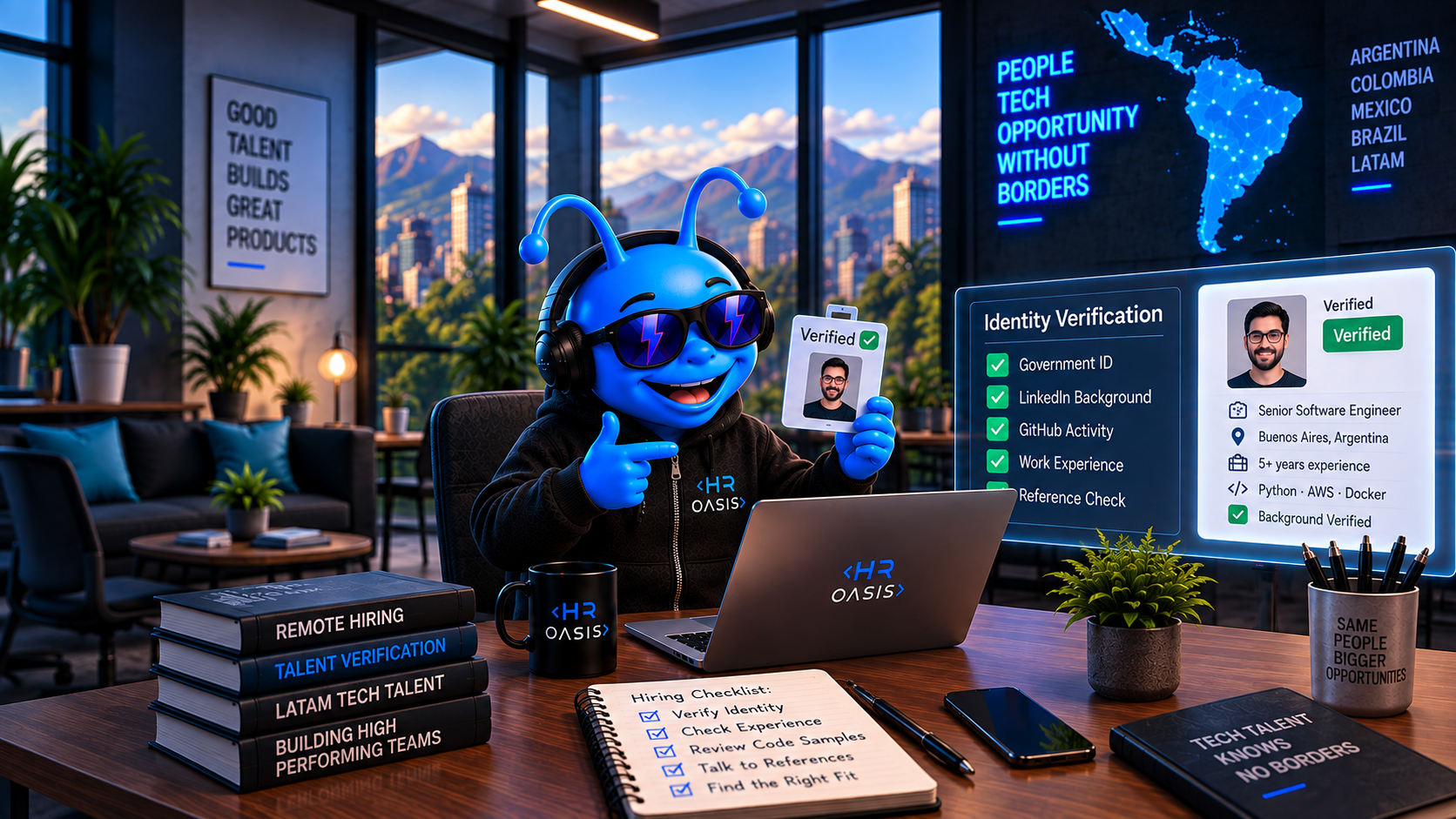
Before spending 30 minutes on a screening call, spend 5 minutes on basic digital consistency checks. Does the LinkedIn profile have a meaningful history, connections that make sense, endorsements from real people who appear to work where they say? Does the GitHub account have commit history that’s consistent with the experience level claimed, and does the code actually reflect the skills on the resume?
A profile created three months ago with no prior posts, a headshot that looks AI-generated, and endorsements from accounts that also look new is worth flagging before you invest interview time. This isn’t proof of fraud, but it’s a signal worth noting.
Use video interviews, and pay attention during them.
The three most reliable real-time signals that something is off: audio and video that are slightly out of sync, lighting or facial edges that don’t quite look natural, and answers that sound read or that lag in a way that suggests someone is typing responses in real time.
The practical countermeasure is asking candidates to do something spontaneous and physically specific. Ask them to hold something up, turn to show a side profile, or write something on paper and show it to the camera. Older deepfake models glitch when rendering occluded or fast-moving faces, so this catches low-effort fakes. Modern deepfake tools increasingly pass this test, so treat it as one layer in a broader process, not as proof either way.
Give a work sample that requires real-time explanation.
The most reliable technical verification is asking someone to walk you through their thinking on a problem live, not just produce a solution. Anyone can paste AI-generated code into a take-home project. Explaining architectural decisions in real time, under follow-up questions, requires actual knowledge.
This doesn’t have to be a long session. A 30-minute pair programming call where you ask the candidate to debug something realistic, explain their approach as they go, and answer questions about why they made specific choices tells you far more about actual ability than any take-home assessment.
Check references through your own network, not just the ones they provide.
References provided by candidates are by definition the people most likely to give a positive account. The more useful verification is reaching someone who knows the candidate’s work through your own network.
In the LATAM tech market, this is more feasible than it sounds. The senior developer community in Argentina, Colombia, and Mexico is smaller and more interconnected than it appears from the outside. A warm introduction or a LinkedIn mutual connection often gets you an honest conversation that a cold reference call wouldn’t.
When you can only use provided references, make the questions specific. Not “was she a good employee” but “can you describe a technical decision she made that you disagreed with at the time? How did it turn out?” Specific questions are harder to answer with generic praise.
Verify identity formally before the offer, not after.
For remote roles involving access to sensitive systems, formal identity verification should happen before an offer is extended, not as part of onboarding. This means checking a government-issued ID against the name on the application, and matching the photo against what you saw in interviews.
This step feels bureaucratic when you first implement it but becomes routine quickly. The candidates who object to basic identity verification are providing useful information.
What This Looks Like in Practice for LATAM Hiring
The framework above is abstract. Here’s how it plays out in a typical LATAM tech search.
You’re hiring a senior backend engineer, someone who will have commit access to your main repository and the ability to deploy to staging. You’ve received 40 applications. Before scheduling calls, a junior team member does 5-minute digital consistency checks on the top 15. Three profiles have thin or suspicious digital footprints and get moved to a separate pile for a second look.
The 12 you screen have video calls. One candidate’s video quality is strange, audio lags slightly during technical questions, and answers sound read rather than thought through in real time. You ask them to sketch something on paper and show the camera. They say their camera can’t move. You move on.
The remaining candidates do a take-home project. A few submit unusually polished solutions. You invite the top candidates to a 30-minute pair programming session where you ask them to explain their take-home code in detail and make a live modification. Two of the “polished” solutions fall apart immediately under live questioning. One candidate clearly wrote their own code and can discuss it fluently.
Before extending the offer, you run a quick reference call through a mutual LinkedIn connection and verify the finalist’s government ID. Everything is consistent.
This process adds maybe three to four hours to a search. In exchange, you have reasonable confidence that the person starting the job is the person you interviewed.
The Role of a Recruiting Partner in Verification
Most companies hiring remotely from LATAM do not have the local network to run reference checks through their own contacts. They’re calling candidates they’ve never heard of from a country where they don’t have professional relationships.
This is one of the clearest practical advantages of working with a recruiting firm that has years of history in specific LATAM markets. The network is already there. We know who worked where, we can reach people who worked alongside a candidate through existing relationships, and we’ve seen enough candidates to recognize inconsistencies that wouldn’t register for someone running their first LATAM search.
At HR Oasis, verification is built into how we present candidates. By the time we introduce someone to a client, we’ve checked their digital footprint, done a technical validation, and spoken to at least one reference that didn’t come from the candidate directly. That doesn’t mean fraud is impossible, but it means the clients we work with aren’t doing this work alone.
If you’re hiring remotely in Argentina, Colombia, Mexico, or elsewhere in LATAM and you want to understand how we approach candidate verification, we’re happy to walk through it.
📩 info@hroasis.com 🔗 hroasis.com/contact