Table of Contents
- The Meeting Problem Nobody Wants to Admit
- What Async-First Actually Means (And What It Doesn’t)
- Why Engineering Teams Specifically Benefit Most
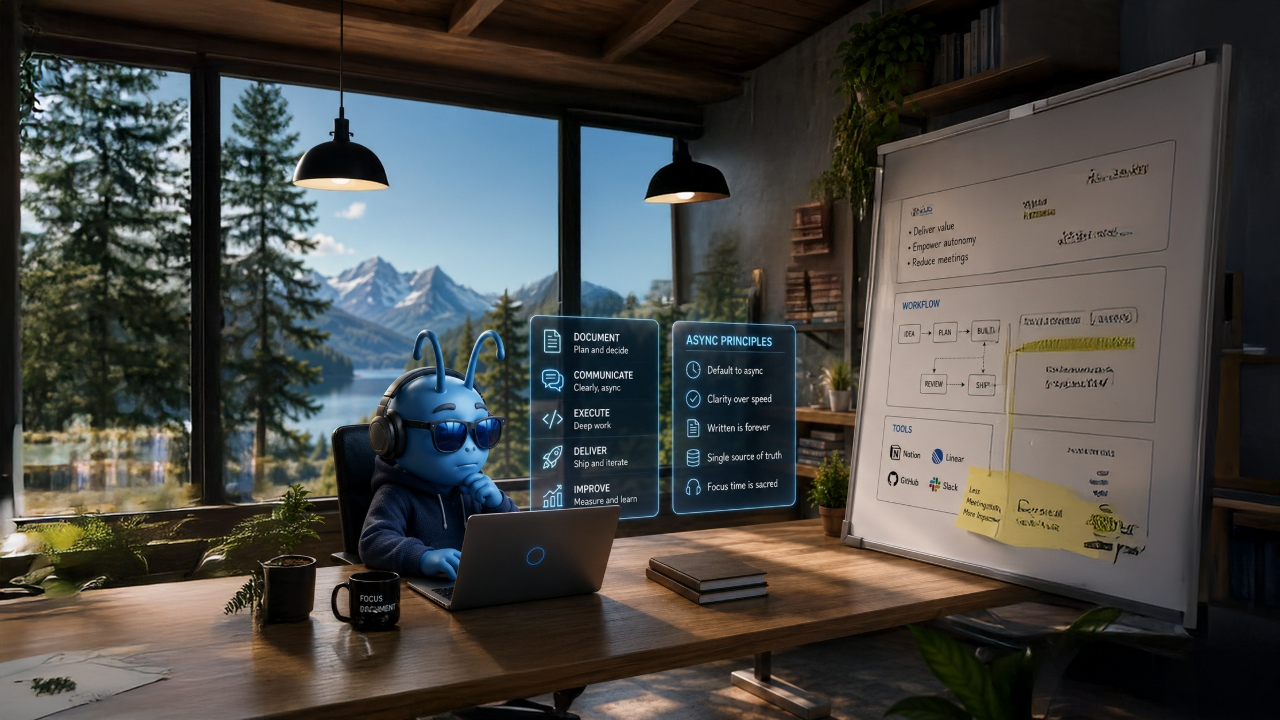
- The Async-First Framework: Six Layers
- Layer One: Communication Tiers
- Layer Two: Documentation as Infrastructure
- Layer Three: Decision-Making Without Synchrony
- Layer Four: Visibility Without Check-Ins
- Layer Five: Meetings That Earn Their Place
- Layer Six: Async Rituals That Build Cohesion
- How to Transition Your Team in 30 Days
- The Latam Advantage: Why Async Works Better With Closer Timezones
- Common Failures and How to Avoid Them
- How HR Oasis Builds Async-Ready Teams
- Frequently Asked Questions
“Async-first approaches now rule because real-time everything drains energy across zones. Clear channels, documented decisions, and intentional connection rituals fix 80% of typical headaches. Tools matter, but norms and habits matter more.” – Remote Team Communication Research, 2026
It’s 2 PM on a Tuesday. Your senior engineer in Buenos Aires is three hours into a deep focus session, finally making real progress on the authentication refactor that’s been blocked for two weeks.
Then the Zoom invite lands. “Quick sync — 30 mins.” From your product manager in San Francisco. About a feature that was already discussed in Slack last Thursday.
The engineer joins. Spends 28 minutes listening to context she already has. Contributes two sentences. The call ends. She tries to get back into the code. The focus is gone. The afternoon is gone.
Multiply this by four engineers, three times a week, and you’ve just burned 24 hours of deep engineering work on meetings that didn’t need to happen.
This isn’t a hypothetical. According to research on distributed engineering teams, the average knowledge worker now attends more meetings than ever, yet studies from Atlassian show that many workers feel those meetings accomplish less than they used to. Remote managers lost the visual cue of seeing people at their desks, so they ask for more updates. Engineers worry they’re invisible, so they over-document. The outcome is performative productivity: showing you’re working instead of actually working.
In 2026, the best remote engineering teams are async-first by design, not by accident. They ship faster, retain better engineers, and operate more smoothly across timezones than teams that try to replicate the office on video.
This is the complete framework for building one.
What Async-First Actually Means (And What It Doesn’t)
Let’s be precise, because this term gets misused constantly.
Async-first means the default mode of communication does not require both parties to be available at the same time. Updates are written. Decisions are documented. Status is visible without a meeting. Synchronous time, calls, standups, and reviews are reserved for things that genuinely need real-time discussion.
Async-first does NOT mean:
No meetings ever. Teams that eliminate all synchronous interaction become isolated and lose cohesion fast. The goal is intentional meetings, not zero meetings.
Slow communication. Async doesn’t mean waiting 48 hours for every response. It means defining appropriate response windows for different communication types, and most of those windows are same-day.
No real-time collaboration. Pair programming, incident response, architecture brainstorms — some work genuinely benefits from synchrony. Async-first teams recognize this and protect those moments.
Documentation as bureaucracy. Written communication isn’t overhead. It’s infrastructure. The teams that do it well spend less time overall, not more.
The distinction that matters: async-first teams default to writing before scheduling. They ask “does this need a meeting?” before sending a calendar invite. And the answer is “no” more often than most teams currently accept.
Why Engineering Teams Specifically Benefit Most
Async-first works for all remote teams, but engineers get disproportionate benefits. Here’s why.
Deep work is their primary output. A designer’s work can often be interrupted and resumed more fluidly. An engineer mid-way through debugging a complex race condition needs sustained focus to hold the entire mental model in their head. Breaking that focus doesn’t just cost the meeting time. It costs 15 to 25 minutes of re-immersion afterward, every single time.
Their work is naturally documentable. Code is written. Pull requests are reviewable. Architecture decisions can be captured in documents. Engineering work already generates artifacts that can replace status meetings.
Code review is already async. Most engineering teams already practice the most important form of async collaboration: pull request review. Engineers don’t hold meetings to review every line of code. They use written comments, approve or request changes, and move on. Async-first just extends this principle to the rest of how the team operates.
Timezone distribution is structural. For US companies building teams in Latin America, some timezone overlap exists but it’s limited. Async-first approaches now rule because real-time everything drains energy across zones. Leaning into async removes the pressure of aligning multiple timezones for every decision.
Many teams report 20 to 40 percent gains in focus time when async becomes the default. For engineers, whose output scales with uninterrupted concentration, that gain is enormous.
The Async-First Framework: Six Layers
Building an async-first engineering team requires deliberate design across six interconnected layers. You can’t just eliminate meetings and call it done. Each layer addresses a different failure mode.
Layer One: Communication Tiers
The foundation of async-first is a clear answer to: where does this conversation belong?
Without explicit tiers, every communication type competes for attention in the same channel. Slack becomes a mix of urgent incidents, casual questions, architectural debates, and memes. Nothing has appropriate urgency or permanence.
Define three tiers explicitly:
Tier 1: Persistent Documentation (Days to Permanent) Where important information lives permanently. Architecture decisions, process documentation, onboarding guides, meeting notes, technical specs.
Tools: Notion, Confluence, GitHub wiki, README files.
Response expectation: None required. This is reference material.
Rule: If a decision or context will matter in three months, it belongs here. If it’s not documented here, it didn’t happen.
Tier 2: Async Communication (Hours) Where work discussion happens. Questions, updates, reviews, proposals, feedback, decisions that don’t need real-time input.
Tools: Slack with defined channels, GitHub PR comments, Loom videos, Linear/Jira comments.
Response expectation: Within 4 hours during working hours for Slack, within 24 hours for PR reviews, within 2 hours for anything tagged urgent.
Rule: Default to this tier for everything that isn’t an emergency. Ask: “Could this wait until someone picks it up when they’re ready?” If yes, it belongs here.
Tier 3: Synchronous Communication (Real-Time) Where genuine real-time interaction happens. Incidents, sensitive conversations, complex architectural debates requiring true brainstorm, relationship-building moments.
Tools: Zoom, Slack huddles, Google Meet.
Response expectation: Immediate when scheduled, within 15 minutes for true urgencies.
Rule: Require justification for why this can’t happen async. The question isn’t “can we meet?” but “why does this specifically need synchrony?”
Implementation step: Create a one-page communication charter. Post it in your team’s main Slack channel and documentation hub. Every team member should be able to answer “where does this go?” for any communication without asking.
Layer Two: Documentation as Infrastructure
Vague or zero context is the second most common async failure mode. Writing well for async takes skill that most teams never explicitly develop.
Async communication only works when messages contain enough context that recipients can act without follow-up. This requires a different writing discipline than office or real-time chat communication.
The async message standard:
Every update, request, or question in async channels should contain:
Why: Why does this matter? What’s the background context?
What: What exactly are you communicating, asking, or proposing?
Next steps: What action, if any, is needed? From whom? By when?
Relevant context: Links, screenshots, error logs, code references — whatever someone needs to engage without asking follow-up questions.
Bad async message: “The deployment failed. What should we do?”
Good async message: “The deployment to staging failed at 2:14 PM UTC due to a database migration conflict (error logs attached in thread). I’ve rolled back to the previous version and documented the issue in the incident log. Two options: (1) fix the migration and retry today before EOD, or (2) postpone to tomorrow’s deployment window. Need a decision from @TechLead by 6 PM UTC to hit today’s window.”
The difference eliminates an entire chain of follow-up questions. The person receiving it can respond with a decision immediately.
Decision logs:
Every significant technical decision should be captured in a lightweight Architecture Decision Record (ADR). Not a lengthy document. A structured note with: context (what problem were we solving?), options considered, decision made, and rationale.
This eliminates three categories of recurring meetings: “Why did we build it this way?”, “What was the context for this decision?”, and “Should we revisit this?” All of those are answerable from the ADR without scheduling anything.
Implementation step: Create a message template for your team’s async communication. Add it to your team documentation. Run a 30-minute session showing examples of good versus weak async messages, and commit to calling out weak patterns in code reviews and retrospectives.
Layer Three: Decision-Making Without Synchrony
Decisions are the most common excuse for unnecessary meetings. “We need to align on this” is the standard justification for a 60-minute call with seven engineers.
Most decisions don’t actually need seven people on a call simultaneously. They need structured async input followed by a clear decision owner acting.
The RFC (Request for Comments) process:
For any significant technical decision (architecture choices, tooling changes, process modifications), use a lightweight RFC:
- Decision owner writes a document: background, problem, proposed solution, alternatives considered, what input is needed and from whom.
- Stakeholders have 48 to 72 hours to comment asynchronously.
- Decision owner reads all input and makes the call.
- Decision is documented with rationale.
The RFC process surfaces all perspectives without requiring everyone online simultaneously. It creates a written record. And it clearly designates one person as the decision maker rather than letting decisions dissolve into committee ambiguity.
Decision tiers by scope:
Not every decision needs an RFC. Create a lightweight framework:
Individual decisions (affects only one person’s work): Engineer decides alone, no notification needed.
Team decisions (affects team workflow): RFC with 24-hour comment window, tech lead decides.
Cross-team decisions (affects multiple teams): RFC with 48-hour window, engineering manager or director decides.
Strategic decisions (affects product direction): Requires sync discussion, then documented decision.
Implementation step: Pick one recurring decision type your team currently handles in meetings (sprint planning debates, tech stack choices, process changes). Replace the meeting with an RFC for two sprints. Compare quality of decision and time spent.
Layer Four: Visibility Without Check-Ins
The deepest anxiety managers have about async teams is losing visibility. “How do I know people are working?” becomes “how do I know what’s happening?”
The answer isn’t more check-ins. It’s making work visible by default.
Async standups:
Replace the 15-minute daily video standup with a written update posted in a dedicated Slack channel. Each engineer posts when it fits their schedule (not at a prescribed time):
What did I complete since my last update? What am I working on now? What, if anything, is blocking me?
This takes 3 minutes to write versus 15 minutes on a call. It’s searchable. It creates a record. And it surfaces blockers just as effectively as a synchronous standup.
Critically: managers should respond to blockers within 2 hours when flagged. The purpose of the standup isn’t attendance, it’s unblocking. Async achieves this better when response SLAs are enforced.
Visible work boards:
Every piece of work should be visible in Linear, Jira, or equivalent with current status, owner, and updated notes. Work in progress shouldn’t live only in someone’s head or private notes.
The rule: if it’s not on the board, it doesn’t exist. This isn’t bureaucracy. It’s making ambient context accessible to people who aren’t in the same office.
Loom for context-heavy updates:
Some updates benefit from showing rather than telling. Bug reproduction, design reviews, architecture walkthroughs. These work well as async video recordings (2 to 5 minutes), watched by recipients when it suits them. Loom with automatic transcription means content is searchable and accessible without a meeting.
Implementation step: Run a two-week experiment. Move daily standup to async written updates. Have everyone post their update in a dedicated channel. Track whether blockers get resolved as fast as in sync standups. Almost every team that tries this doesn’t go back.
Layer Five: Meetings That Earn Their Place
Async-first doesn’t mean eliminating meetings. It means requiring meetings to justify their existence.
The meeting audit:
List every recurring meeting your team has. For each one, ask:
Does this require real-time interaction, or could the goal be achieved async? Is the content discussion or information sharing? (Information sharing = async) Does the output require live debate, or just a decision? (Decisions = async RFC)
Most teams find 40 to 60 percent of their recurring meetings can be replaced or eliminated through this audit.
Meetings that are worth keeping:
Sprint retrospectives: Live discussion of team dynamics, process issues, and interpersonal tensions benefits from synchrony and immediate response.
Architecture brainstorms: When the problem space is genuinely unknown and exploration requires real-time building on each other’s ideas.
1-on-1s: Relationship-building, feedback, career conversations. These require human connection that async can’t replicate.
Incident response: Real-time coordination when systems are down.
Quarterly team offsites: Intentional relationship-building time. Worth the investment even for fully async teams.
Meetings that are not worth keeping:
Status updates of any kind. These belong in async channels. Decision meetings where one person could decide with async input. Information sharing sessions. Record a Loom instead. “Alignment” meetings without a specific decision to make.
Meeting hygiene for the meetings that remain:
Every meeting needs a written agenda posted at least 24 hours before. No agenda, no meeting.
Decisions from every meeting are documented in writing within 24 hours. Action items with owners and due dates.
Meeting recordings available for team members in different timezones who couldn’t attend.
Implementation step: Do the meeting audit with your team in a retrospective. Have each person vote on which meetings they find valuable versus draining. The overlap between “draining” and “could be async” is usually 70 percent.
Layer Six: Async Rituals That Build Cohesion
The biggest concern about async-first teams is cultural: won’t people feel isolated? Won’t the team lose cohesion?
This is a real risk, but it’s solved by designing for connection deliberately rather than hoping it happens in meetings.
Weekly team digest:
Every Friday, one team member (rotating) posts a brief written summary: what shipped this week, interesting technical things that happened, team highlights, anything worth celebrating. This creates shared narrative without requiring everyone on a call.
Async wins channel:
A dedicated Slack channel for celebrating completions, shipping features, fixing hard bugs, getting positive user feedback. Public recognition async works, especially when it’s specific and timely. “The auth refactor shipped without any issues in production — fantastic work navigating that migration complexity” lands just as well in Slack as in a meeting.
Interest channels for human connection:
Slack channels for non-work interests where people can show up as humans: football, books, pets, coffee, local food. These feel trivial but they build the casual connection that replaces water cooler conversation. The key is making them optional and low-pressure.
Occasional intentional synchrony:
Quarterly or semi-annual team gatherings, either virtual with real agenda or in-person when feasible. For Latin America teams, a two-day offsite twice yearly does more for cohesion than any amount of mandatory virtual coffee chats. These are the moments where relationships that sustain async work get built.
Implementation step: Create three things this week: an async wins channel, a rotating weekly digest practice, and at least one interest channel. Seed all three with content yourself before asking the team to participate.
How to Transition Your Team in 30 Days
Keep it dead simple at first. Over-engineering kills adoption. Here’s a realistic 30-day transition that actually sticks.
Week One: Audit and Charter
Day 1 to 2: List every recurring meeting and communication channel. For each meeting, mark it as “keep sync,” “convert to async,” or “eliminate.”
Day 3 to 4: Draft your communication charter (one page: tiers, tools, response windows).
Day 5: Present audit findings and charter to the team. Get input. Adjust.
Week Two: Quick Wins
Convert daily standup to async written updates. Run this for two weeks before evaluating.
Eliminate the two most obviously unnecessary recurring meetings.
Create the async wins channel and the weekly digest practice.
Post the communication charter in your main Slack and documentation hub.
Week Three: Documentation Infrastructure
Set up ADR (Architecture Decision Record) templates in your documentation hub.
Run one RFC for a pending technical decision instead of scheduling a meeting.
Hold a 30-minute session on async message quality with examples.
Week Four: Reinforce and Adjust
Hold an async retrospective on the transition: what’s working, what’s frustrating, what needs adjustment.
Identify one more meeting to convert or eliminate.
Recognize publicly the best examples of async communication from the past month.
Set a review date 60 days out to evaluate impact.
What to measure:
Track meeting hours reduced per week, response times on blocked items, engineering time in focus sessions (use tools like Clockwise or RescueTime), and team satisfaction scores. Many teams report 20 to 40 percent gains in focus time when async becomes the default.
The Latam Advantage: Why Async Works Better With Closer Timezones
Here’s something most async-first content misses: the framework works even better when your team is distributed across Latin America.
Compare the coordination overhead of a US company with teams in Asia (10 to 16 hours difference) versus Latin America (0 to 3 hours difference).
With Asia, async isn’t a choice, it’s a necessity. The overlap window is so small that most communication must be asynchronous. But the friction is high: an async question sent at 4 PM New York time gets answered 10 hours later.
With Latin America, async is a choice made for quality, not constraint. You have enough overlap (3 to 5 hours daily) for the synchronous moments that genuinely matter: incident response, real-time brainstorms, 1-on-1s. And you use async for everything else, getting the deep work benefits without the coordination delays.
This is why async-first teams with Latin American engineers often outperform both fully co-located teams (where meetings crowd out deep work) and Asia-distributed teams (where async latency slows decisions).
The sweet spot: enough overlap for meaningful synchrony, enough separation to protect focus time, and a cultural work ethic that adapts well to written communication and remote collaboration.
Common Failures and How to Avoid Them
Failure One: Async without documentation standards
Teams go async but never define how to write good async messages. Communication becomes vague and requires follow-up anyway. The meetings just move to Slack threads.
Fix: Define and enforce the “why, what, next steps” message standard. Review examples in retrospectives.
Failure Two: Async without response SLAs
Nobody knows how long they should wait for answers. Urgent things get lost in the noise of non-urgent things. Engineers ping on Slack because there’s no confidence anything else will be seen.
Fix: Define and post response expectations for each channel and tier. Hold to them.
Failure Three: Managers undermining async with sync behavior
The team commits to async standups. Then the manager keeps scheduling “quick syncs” to hear status updates verbally. The team learns async is optional.
Fix: Managers must model the behavior. If you want the team to write updates, stop asking for verbal ones.
Failure Four: No synchronous safety valve
The team goes fully async with no mechanism for genuine urgent coordination. Someone has a production crisis and is posting in Slack waiting for responses.
Fix: Define clear escalation paths for true urgencies. Everyone should know how to signal “this needs immediate human attention” and how that gets routed.
Failure Five: Async as an excuse for disengagement
Some individuals use async culture as cover for being unresponsive or disengaged. “I’m async-first” becomes “I don’t respond to things.”
Fix: Async-first has SLAs. Consistently violating response windows is a performance issue, not a cultural preference. Enforce it.
How HR Oasis Helps Build Async-Ready Teams
When we place engineers in distributed teams at HR Oasis, we screen specifically for the skills that make async-first work: strong written communication, self-direction, ability to give and receive feedback in writing, comfort with documentation.
A technically brilliant engineer who can’t communicate clearly in writing is a liability in an async-first team, regardless of their coding ability. We evaluate both.
We also help companies establish the foundational practices before the first hire joins: communication charters, documentation standards, onboarding documentation that doesn’t require constant hand-holding. The async-first framework works better when new hires join a team that already operates this way, rather than having to figure it out from scratch.
Our Latin American engineering candidates are particularly well-suited to async-first environments. Many have years of experience working with distributed US teams, understand remote work norms, and are accustomed to written communication as primary workflow rather than exception.
Ready to build an engineering team that ships without constant meetings?
📩 Let’s talk: info@hroasis.com
We’ll help you find engineers who thrive async and set up the practices that make distributed collaboration actually work.
Related Articles
- How to Structure Remote Engineering Teams for Work in 2026
- Engineering Culture: How to Build It in Distributed Latam Teams
- Building Your First Remote Team: The 10 Mistakes That Kill Startups
- Remote Team Management: What Actually Works
Frequently Asked Questions
What does async-first actually mean for an engineering team?
Async-first means the default mode of team communication doesn’t require both parties available simultaneously. Updates are written and posted when ready, decisions are documented in structured proposals with comment windows, status is visible through shared boards rather than verbal check-ins, and meetings are reserved for things that genuinely require real-time interaction like incident response, complex brainstorms, and relationship-building. It doesn’t mean no meetings or slow communication. It means every synchronous meeting must justify why it can’t be handled in writing first.
How much does async-first actually improve engineering productivity?
Teams that implement async-first practices report 20 to 40 percent gains in focus time and 40 to 60 percent reductions in meeting hours. For engineers specifically, whose primary output requires sustained concentration, the productivity impact is higher than for other roles. Recovering even 90 minutes of daily deep focus time per engineer has compounding effects on what teams can ship. Beyond individual productivity, async-first teams report better documentation, faster onboarding for new hires, and clearer decision trails that reduce the cost of revisiting past choices.
What’s the difference between async-first and just working remotely?
Most remote teams default to replicating office behavior on video, daily standups on Zoom, meetings for status updates, real-time Slack expected at all hours. Async-first is a deliberate choice to default to writing over scheduling, to treat documentation as infrastructure rather than overhead, and to require meetings to earn their place through a clear need for real-time interaction. Remote work is about location. Async-first is about communication design. You can be in an office and work async-first, and you can work remotely while being stuck in constant synchronous meetings.
How do you prevent people from feeling isolated in an async-first team?
Isolation in async teams comes from the absence of deliberate connection design, not from async communication itself. The solution is designing for connection intentionally through async wins channels for public recognition, rotating weekly team digest posts that create shared narrative, interest channels for non-work conversation, and occasional in-person or focused virtual gatherings for relationship-building. The teams that feel isolated async are the ones that eliminated meetings without replacing the human connection those meetings provided. Async-first and strong team cohesion are compatible when connection is designed for explicitly.
How do you handle urgent issues in an async-first environment?
Async-first teams define clear escalation paths for genuine urgencies that sit outside normal async patterns. Every team member knows how to signal true urgency (a specific emoji in Slack, an alert channel, a PagerDuty integration), what response window that triggers, and who is responsible for immediate response. Production incidents, security issues, and time-sensitive customer situations bypass normal async norms with explicit escalation. The key is defining this clearly upfront so urgency is communicated by the channel or signal used, not by how many times someone pings in Slack.
What’s the hardest part of transitioning to async-first?
The hardest part is manager behavior change. Teams can commit to async standups, written decisions, and documentation standards. But if managers continue asking for verbal status updates, scheduling “quick syncs” to check on progress, and not reading async updates before asking questions they’ve already been answered, the team learns async is optional. Successful async-first transitions require managers to model the behavior: writing updates themselves, reading documentation before asking questions, letting async decision processes complete before calling meetings. Without that, the transition fails regardless of tools or stated commitments.
How does async-first work differently for teams in Latin America versus Asia?
Latin America’s timezone proximity to the US (0 to 3 hours difference) makes async-first a quality choice rather than a coordination constraint. Teams have enough overlap (3 to 5 hours daily) for genuinely synchronous moments like incident response and architecture discussions, while using async for everything else to protect deep work time. With Asia (10 to 16 hours difference), async is forced by necessity but suffers from response latency. A question asked at 4 PM New York time gets answered 10 hours later. Latam async combines the focus benefits of async with same-day response cycles, making it operationally superior to both fully synchronous co-located teams and far-timezone distributed teams.
What tools do async-first engineering teams actually need?
The core stack is simpler than most teams think: Notion or Confluence for persistent documentation, Slack with defined channel norms for async communication, Linear or Jira for visible work tracking, Loom for async video walkthroughs, and Zoom or similar for the synchronous meetings that earn their place. The tools matter less than the norms around them. A team with clear communication tiers and response expectations on basic tools outperforms a team with sophisticated tooling but unclear norms. Start with tools you already have and build the norms. Add tooling only when you have a specific gap the norms can’t address.
How long does it take to transition a team to async-first?
A realistic transition timeline is 30 days for initial implementation and 90 days to genuinely feel natural. Week one is audit and charter creation. Week two introduces the first quick wins: async standups, eliminating obvious unnecessary meetings, creating connection channels. Week three builds documentation infrastructure and runs first async decision processes. Week four reinforces and adjusts based on what’s working. The full cultural shift, where async is default without people reverting to meeting requests under pressure, takes another 60 days of consistent practice. Most teams that run the transition honestly report it’s the most significant operational improvement they’ve made.
Should every team go async-first?
Async-first is most valuable for engineering teams, knowledge workers with deep work requirements, and distributed teams spanning multiple timezones. It’s less suited to roles requiring rapid real-time coordination (like customer support or live operations), very early-stage teams of two to three people where synchrony is low-friction, or teams whose primary output is highly collaborative real-time work. For the vast majority of remote engineering teams building software products, async-first delivers clear productivity gains, better documentation, and higher engineer satisfaction. The question isn’t whether to try it but how to implement it in a way that actually sticks.